3.5 million new businesses opened in 2024 in the EU

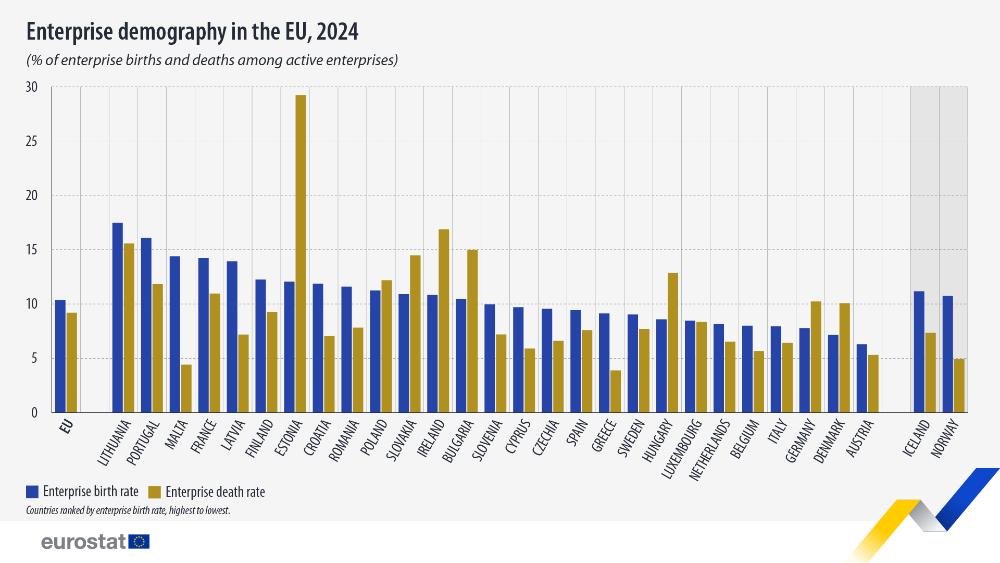
In 2024, there were 34 million enterprises in the EU, of which 3.5 million were created that year. At the same period, 3.1 million enterprise deaths were registered. This resulted in an enterprise birth rate of 10.4% and a death rate of 9.2%.
This information comes from data on business demography published by Eurostat today. The article presents a handful of findings from the more detailed Statistics Explained article on business demography.
Source dataset: bd_size
In 19 of the 27 EU countries, more companies were created than dissolved in 2024. On the contrary, in Bulgaria, Denmark, Germany, Estonia, Ireland, Hungary, Poland and Slovakia, the number of enterprises dissolved surpassed the number of companies created.
The highest enterprise birth rates were recorded in Lithuania (17.5%), Portugal (16.1%), Malta (14.4%) and France (14.2%). By contrast, the lowest rates were registered in Austria (6.3%), Denmark (7.2%) and Germany (7.8%).
On the other hand, the highest preliminary death rates of enterprises were registered in Estonia (29.2%), Ireland (16.9%) and Lithuania (15.6%). The lowest rates were registered in Greece (3.9%), Malta (4.4%) and Austria (5.3%).
In 2024, there were 180 200 enterprises that had at least 10 employees at the beginning of a 3-year period preceding 2024 and recorded an average annual growth in the number of employees above 10%. These high-growth enterprises made up 10.0% of EU enterprises with at least 10 employees and provided work for 14.1 million people.
For more information
- Statistics Explained article on business demography
- Thematic section on business demography
- Database on business demography
- Data visualisation on business demography
Methodological notes
- Business demography provides statistics on enterprise births, survival rates (up to five years after birth), and deaths within the business population. It also tracks enterprise growth in terms of employment. These statistics show how the number of enterprises in the business economy changes from year to year. Such changes may reflect factors such as competition, entrepreneurial activity, and the business environment.
- The Business Demography Statistics are compiled along the requirements of the framework for European Business Statistics.
- Enterprise birth amounts to the creation of a combination of production factors, with the restriction that no other enterprises are involved in the event. Births do not include entries into the business population due to mergers, break-ups, split-offs or restructuring of a set of enterprises, nor do the statistics include entries into a sub-population that only result from a change of activity.
- Enterprise birth rate: the number of enterprise births in the reference period divided by the number of enterprises active in that same period.
- Enterprise death is the termination of an enterprise, amounting to the dissolution of a combination of production factors, with the restriction that no other enterprises are involved in the event. An enterprise is only included in the count of deaths if it is not reactivated within 2 years. Equally, a reactivation within 2 years is not counted as a birth. Consequently, the 2024 data on enterprise deaths are preliminary.
- Enterprise death rate: the number of enterprise deaths in the reference period divided by the number of enterprises active in that same period.
- A high-growth enterprise is an enterprise with average annualised growth in the number of employees greater than 10% per year over a 3-year period, which had at least 10 employees at the beginning of the growth period (three years earlier), and was not an enterprise birth.
- Share of high-growth enterprises: number of high-growth enterprises divided by number of active enterprises having at least 10 employees.
For information on upcoming releases, visit our release calendar. If you have any queries, please visit our contact us page.


