Euro area unemployment at 6.1% (4.3.2026)
Overview
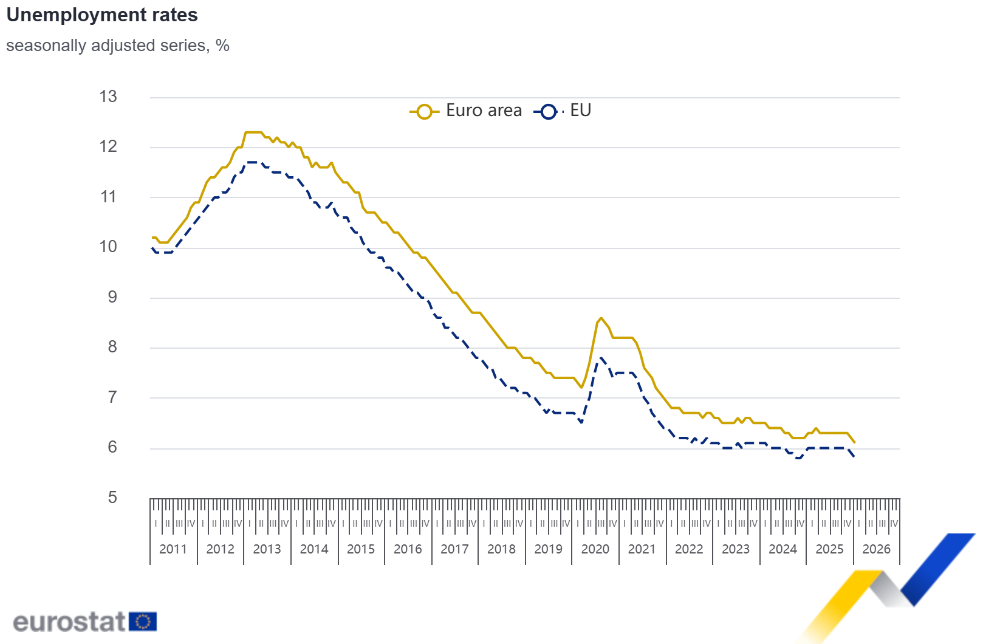
In January 2026, the euro area seasonally adjusted unemployment rate was 6.1%, down from 6.2% in December 2025 and from 6.3% in January 2025. The EU unemployment rate was 5.8% in January 2026, also down from 5.9% in December 2025 and from 6.0% in January 2025. These figures are published by Eurostat, the statistical office of the European Union.
Eurostat estimates that 12.928 million persons in the EU, of whom 10.770 million in the euro area, were unemployed in January 2026.
-
Compared with December 2025, unemployment decreased by 185 thousand in the EU and by 184 thousand in the euro area.
-
Compared with January 2025, unemployment decreased by 274 thousand in the EU and by 273 thousand in the euro area.
Youth unemployment
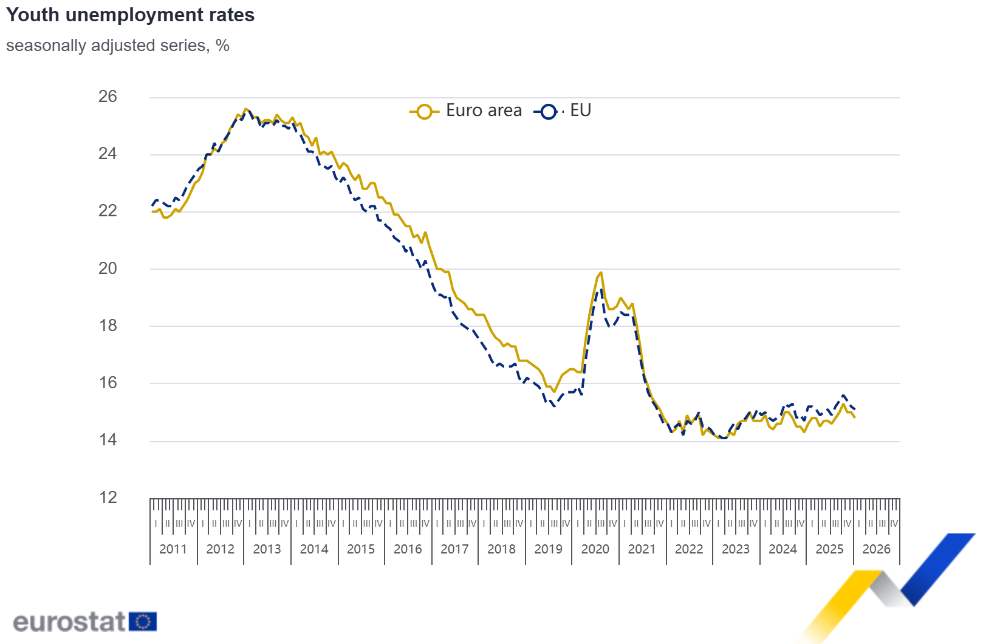
In January 2026, 2.922 million young persons (under 25) were unemployed in the EU, of whom 2.352 million were in the euro area. In January 2026, the youth unemployment rate was 15.1% in the EU, down from 15.2% in the previous month, and 14.8% in the euro area, also down from 15.0% in December 2025.
-
Compared with December 2025, youth unemployment decreased by 27 thousand in the EU as well as in the euro area.
-
Compared with January 2025, youth unemployment decreased by 27 thousand in the EU and increased by 12 thousand in the euro area.
Unemployment by sex
In January 2026, the unemployment rate for women was 6.0% in the EU, down from 6.1% in December 2025, and the unemployment rate for men was 5.7%, also down from 5.8% in the previous month. In the euro area, the unemployment rate for women was 6.3%, down from 6.4% in December 2025, and the unemployment rate for men was 6.0%, also down from 6.1% in the previous month.
Additional labour market indicators
The estimates in this News Release are based on the globally used International Labour Organisation (ILO) standard definition of unemployment, which counts as unemployed people without a job who have been actively seeking work in the last four weeks and are available to start work within the next two weeks.
To capture in full the labour market situation, the data on unemployment have been complemented by additional indicators, e.g. underemployed part-time workers, persons seeking work but not immediately available and persons available to work but not seeking, released together with EU Labour Force Survey (EU-LFS) data for the third quarter of 2025.
EU-LFS data for the fourth quarter of 2025 will be released on 13 March 2026.
Tables
|
Seasonally adjusted unemployment, totals |
||||||||||
|---|---|---|---|---|---|---|---|---|---|---|
|
Rates (%) |
Number of persons (in thousands) |
|||||||||
|
Jan-25 |
Oct-25 |
Nov-25 |
Dec-25 |
Jan-26 |
Jan-25 |
Oct-25 |
Nov-25 |
Dec-25 |
Jan-26 |
|
|
Euro area 21 |
6.3 | 6.3 | 6.3 | 6.2 |
6.1 |
11 043 | 11 140 | 11 026 | 10 954 |
10 770 |
|
Euro area 20 |
6.3 | 6.4 | 6.3 | 6.3 |
6.2 |
10 932 | 11 037 | 10 927 | 10 858 |
10 676 |
|
EU |
6.0 | 6.0 | 6.0 | 5.9 |
5.8 |
13 202 | 13 361 | 13 229 | 13 113 |
12 928 |
|
Belgium |
6.1 | 6.4 | 6.4 | 6.5 |
6.4 |
331 | 350 | 350 | 356 |
354 |
|
Bulgaria |
3.6 | 3.4 | 3.3 | 3.2 |
3.1 |
111 | 104 | 99 | 96 |
94 |
|
Czechia |
2.5 | 3.2 | 3.2 | 3.1 |
3.2 |
134 | 171 | 169 | 165 |
174 |
|
Denmark |
6.6 | 6.7 | 6.6 | 6.1 |
7.5 |
219 | 219 | 214 | 202 |
247 |
|
Germany |
3.5 | 3.9 | 3.9 | 4.0 |
4.0 |
1 553 | 1 711 | 1 729 | 1 743 |
1 749 |
|
Estonia |
7.6 | 6.9 | 6.5 | 6.5 |
6.3 |
57 | 51 | 48 | 49 |
47 |
|
Ireland |
4.5 | 4.7 | 4.6 | 4.7 |
4.7 |
130 | 138 | 135 | 138 |
138 |
|
Greece |
9.8 | 8.8 | 8.4 | 7.9 |
7.7 |
462 | 422 | 403 | 373 |
369 |
|
Spain |
10.9 | 10.2 | 10.1 | 10.0 |
9.8 |
2 665 | 2 547 | 2 519 | 2 504 |
2 469 |
|
France |
7.3 | 7.9 | 7.9 | 7.8 |
7.7 |
2 288 | 2 521 | 2 503 | 2 486 |
2 461 |
|
Croatia |
5.0 | 4.7 | 4.6 | 4.6 |
4.5 |
88 | 84 | 82 | 81 |
80 |
|
Italy |
6.6 | 5.8 | 5.6 | 5.5 |
5.1 |
1 689 | 1 472 | 1 423 | 1 405 |
1 305 |
|
Cyprus |
4.5 | 4.1 | 4.2 | 4.2 |
4.2 |
23 | 22 | 22 | 22 |
23 |
|
Latvia |
7.1 | 6.9 | 6.9 | 6.9 |
6.9 |
67 | 66 | 65 | 65 |
65 |
|
Lithuania |
6.8 | 6.7 | 6.7 | 6.7 |
6.4 |
107 | 105 | 104 | 104 |
101 |
|
Luxembourg |
6.5 | 6.5 | 6.8 | 6.8 |
6.9 |
23 | 23 | 24 | 24 |
24 |
|
Hungary |
4.3 | 4.5 | 4.4 | 4.5 |
4.5 |
210 | 221 | 215 | 216 |
220 |
| 3.3 | 3.0 | 3.1 | 3.2 |
3.4 |
11 | 10 | 11 | 11 |
12 |
|
|
Netherlands |
3.8 | 4.0 | 4.0 | 4.0 |
4.0 |
386 | 411 | 408 | 410 |
415 |
|
Austria |
5.5 | 5.8 | 5.9 | 5.8 |
5.6 |
261 | 280 | 280 | 280 |
268 |
|
Poland |
3.0 | 3.2 | 3.2 | 3.2 |
3.1 |
535 | 576 | 571 | 567 |
563 |
|
Portugal |
6.3 | 5.8 | 5.7 | 5.6 |
5.6 |
349 | 328 | 318 | 314 |
315 |
|
Romania |
6.0 | 6.1 | 6.3 | 6.1 |
6.0 |
495 | 496 | 512 | 499 |
491 |
|
Slovenia |
3.9 | 4.2 | 4.2 | 4.1 |
3.9 |
40 | 43 | 43 | 42 |
40 |
|
Slovakia |
5.2 | 5.5 | 5.6 | 5.6 |
5.6 |
144 | 153 | 153 | 155 |
155 |
|
Finland |
8.9 | 10.0 | 10.1 | 10.2 |
10.2 |
255 | 288 | 291 | 293 |
294 |
|
Sweden |
8.7 | 8.8 | 8.8 | 8.7 |
8.7 |
498 | 508 | 506 | 505 |
502 |
|
Iceland |
3.8 | 4.8 | 5.1 | 5.2 |
5.3 |
9 | 11 | 12 | 12 |
12 |
|
Norway |
4.1 | 4.5 | 4.5 | 4.5 |
4.5 |
125 | 137 | 137 | 136 |
136 |
|
Switzerland |
4.5 | 5.1 | 5.2 | 5.1 |
: |
228 | 264 | 266 | 262 |
: |
|
United States |
4.0 | : | 4.5 | 4.4 |
4.3 |
6 897 | : | 7 859 | 7 516 |
7 387 |
|
: Data not available Source datasets: une_rt_m (rates) and une_rt_m (in 1 000 persons)
|
||||||||||

|
Seasonally adjusted youth (under 25s) unemployment |
||||||||||
|---|---|---|---|---|---|---|---|---|---|---|
|
Rates (%) |
Number of persons (in thousands) |
|||||||||
|
Jan-25 |
Oct-25 |
Nov-25 |
Dec-25 |
Jan-26 |
Jan-25 |
Oct-25 |
Nov-25 |
Dec-25 |
Jan-26 |
|
|
Euro area 21 |
14.6 | 15.3 | 15.0 | 15.0 |
14.8 |
2 340 | 2 440 | 2 392 | 2 379 |
2 352 |
|
Euro area 20 |
14.7 | 15.3 | 15.1 | 15.0 |
14.8 |
2 329 | 2 425 | 2 377 | 2 365 |
2 337 |
|
EU |
15.2 | 15.6 | 15.4 | 15.2 |
15.1 |
2 949 | 3 031 | 2 975 | 2 949 |
2 922 |
|
Belgium |
17.3 | 18.5 | 18.5 | 18.5 |
: |
83 | 89 | 89 | 89 |
: |
|
Bulgaria |
9.8 | 13.2 | 12.7 | 12.3 |
12.4 |
11 | 15 | 15 | 15 |
15 |
|
Czechia |
11.3 | 10.6 | 10.0 | 10.1 |
10.0 |
33 | 33 | 30 | 33 |
32 |
|
Denmark |
15.5 | 14.1 | 13.7 | 13.0 |
15.3 |
77 | 74 | 68 | 65 |
79 |
|
Germany |
6.8 | 7.1 | 7.1 | 7.1 |
7.1 |
309 | 320 | 320 | 320 |
319 |
|
Estonia |
17.6 | 19.4 | 17.5 | 16.0 |
15.9 |
11 | 11 | 10 | 9 |
9 |
|
Ireland |
11.4 | 11.6 | 11.3 | 11.4 |
11.8 |
41 | 42 | 42 | 43 |
45 |
|
Greece |
21.2 | 19.2 | 18.2 | 13.9 |
16.0 |
55 | 50 | 47 | 34 |
38 |
|
Spain |
26.2 | 24.2 | 23.6 | 23.5 |
23.5 |
464 | 442 | 431 | 431 |
437 |
|
France |
18.5 | 21.4 | 21.4 | 21.2 |
20.9 |
620 | 736 | 737 | 726 |
717 |
|
Croatia |
18.0 | 17.6 | 17.6 | 17.6 |
: |
21 | 20 | 20 | 20 |
: |
|
Italy |
21.0 | 20.3 | 19.4 | 20.9 |
18.9 |
297 | 259 | 240 | 266 |
232 |
|
Cyprus |
11.0 | 15.0 | 15.0 | 15.0 |
: |
3 | 5 | 5 | 5 |
: |
|
Latvia |
13.9 | 14.2 | 15.0 | 15.3 |
15.3 |
9 | 9 | 10 | 10 |
10 |
|
Lithuania |
14.6 | 14.2 | 14.6 | 14.9 |
15.2 |
15 | 14 | 14 | 15 |
15 |
|
Luxembourg |
18.5 | 18.2 | 19.4 | 19.2 |
19.7 |
5 | 4 | 5 | 5 |
5 |
|
Hungary |
13.7 | 14.1 | 13.1 | 14.4 |
14.0 |
42 | 41 | 37 | 41 |
40 |
| 9.1 | 11.4 | 11.6 | 12.1 |
12.8 |
3 | 3 | 3 | 4 |
4 |
|
|
Netherlands |
8.9 | 9.0 | 9.1 | 9.2 |
9.3 |
162 | 161 | 163 | 165 |
168 |
|
Austria |
10.5 | 12.3 | 11.1 | 10.3 |
10.2 |
56 | 65 | 58 | 54 |
55 |
|
Poland |
12.4 | 11.5 | 11.2 | 11.1 |
11.0 |
141 | 130 | 125 | 124 |
122 |
|
Portugal |
20.3 | 19.0 | 18.9 | 18.6 |
18.2 |
78 | 70 | 70 | 69 |
69 |
|
Romania |
25.7 | 28.2 | 28.2 | 28.2 |
: |
127 | 138 | 138 | 138 |
: |
|
Slovenia |
12.0 | 11.6 | 11.6 | 11.6 |
: |
9 | 9 | 9 | 9 |
: |
|
Slovakia |
15.8 | 15.4 | 15.1 | 14.8 |
14.7 |
23 | 20 | 20 | 20 |
20 |
|
Finland |
20.2 | 22.2 | 22.4 | 22.6 |
22.7 |
67 | 76 | 76 | 76 |
77 |
|
Sweden |
23.9 | 24.1 | 24.1 | 24.0 |
23.9 |
163 | 170 | 170 | 170 |
169 |
|
Iceland |
9.0 | 10.1 | 10.5 | 10.8 |
10.9 |
3 | 4 | 4 | 4 |
4 |
|
Norway |
11.5 | 13.9 | 15.1 | 12.7 |
14.1 |
51 | 62 | 65 | 58 |
61 |
|
Switzerland |
8.3 | 9.4 | 9.6 | 9.4 |
: |
49 | 56 | 57 | 56 |
: |
|
: Data not available Belgium, Croatia, Cyprus, Romania and Slovenia: quarterly data Source datasets: une_rt_m (rates) and une_rt_m (in 1 000 persons)
|
||||||||||
|
Seasonally adjusted unemployment rates (%), by sex |
||||||||||
|---|---|---|---|---|---|---|---|---|---|---|
|
Males |
Females |
|||||||||
|
Jan-25 |
Oct-25 |
Nov-25 |
Dec-25 |
Jan-26 |
Jan-25 |
Oct-25 |
Nov-25 |
Dec-25 |
Jan-26 |
|
|
Euro area 21 |
6.1 | 6.2 | 6.1 | 6.1 |
6.0 |
6.6 | 6.5 | 6.4 | 6.4 |
6.3 |
|
Euro area 20 |
6.1 | 6.2 | 6.2 | 6.1 |
6.0 |
6.6 | 6.6 | 6.5 | 6.4 |
6.3 |
|
EU |
5.8 | 5.9 | 5.9 | 5.8 |
5.7 |
6.2 | 6.2 | 6.1 | 6.1 |
6.0 |
|
Belgium |
6.7 | 6.6 | 6.5 | 6.6 |
6.5 |
5.4 | 6.2 | 6.3 | 6.4 |
6.4 |
|
Bulgaria |
3.9 | 3.6 | 3.5 | 3.3 |
3.3 |
3.4 | 3.3 | 3.1 | 3.0 |
2.9 |
|
Czechia |
2.4 | 2.9 | 2.8 | 2.5 |
2.8 |
2.7 | 3.5 | 3.5 | 3.7 |
3.7 |
|
Denmark |
6.5 | 6.8 | 6.3 | 6.4 |
6.6 |
6.8 | 6.6 | 6.8 | 5.8 |
8.4 |
|
Germany |
3.8 | 4.2 | 4.2 | 4.3 |
4.3 |
3.3 | 3.5 | 3.6 | 3.6 |
3.6 |
|
Estonia |
7.7 | 8.3 | 8.0 | 7.6 |
7.1 |
7.4 | 5.5 | 5.0 | 5.5 |
5.5 |
|
Ireland |
4.5 | 4.7 | 4.6 | 4.8 |
4.8 |
4.4 | 4.7 | 4.5 | 4.5 |
4.5 |
|
Greece |
8.1 | 6.9 | 6.4 | 5.7 |
5.4 |
11.8 | 11.2 | 10.9 | 10.5 |
10.5 |
|
Spain |
9.7 | 8.9 | 8.9 | 8.8 |
8.7 |
12.2 | 11.7 | 11.4 | 11.3 |
11.2 |
|
France |
7.3 | 8.1 | 8.1 | 8.1 |
8.0 |
7.3 | 7.8 | 7.6 | 7.6 |
7.5 |
|
Croatia |
5.4 | 5.2 | 5.1 | 5.0 |
5.0 |
4.5 | 4.2 | 4.1 | 4.0 |
4.0 |
|
Italy |
5.9 | 5.5 | 5.4 | 5.4 |
5.0 |
7.4 | 6.1 | 5.8 | 5.7 |
5.3 |
|
Cyprus |
3.9 | 3.8 | 3.9 | 3.9 |
4.0 |
5.2 | 4.5 | 4.4 | 4.5 |
4.4 |
|
Latvia |
8.4 | 7.8 | 7.7 | 7.9 |
8.0 |
5.9 | 6.1 | 6.0 | 5.9 |
5.7 |
|
Lithuania |
7.8 | 7.9 | 7.9 | 8.1 |
7.8 |
5.8 | 5.5 | 5.4 | 5.3 |
5.1 |
|
Luxembourg |
6.4 | 6.3 | 6.6 | 6.5 |
6.6 |
6.6 | 6.8 | 7.1 | 7.1 |
7.3 |
|
Hungary |
4.3 | 4.6 | 4.6 | 4.5 |
4.6 |
4.2 | 4.4 | 4.2 | 4.3 |
4.4 |
| 3.3 | 3.1 | 3.2 | 3.3 |
3.5 |
3.4 | 2.8 | 3.0 | 3.0 |
3.2 |
|
|
Netherlands |
3.6 | 3.9 | 3.9 | 3.9 |
4.0 |
4.0 | 4.1 | 4.1 | 4.1 |
4.1 |
|
Austria |
5.6 | 6.5 | 6.5 | 5.7 |
5.8 |
5.3 | 5.2 | 5.2 | 6.0 |
5.3 |
|
Poland |
2.8 | 3.0 | 3.0 | 3.0 |
3.0 |
3.3 | 3.5 | 3.4 | 3.3 |
3.3 |
|
Portugal |
6.1 | 5.1 | 5.1 | 5.0 |
5.0 |
6.6 | 6.5 | 6.3 | 6.2 |
6.2 |
|
Romania |
6.1 | 6.2 | 6.3 | 6.0 |
6.0 |
6.0 | 5.9 | 6.3 | 6.2 |
5.9 |
|
Slovenia |
3.5 | 3.6 | 3.6 | 3.4 |
3.3 |
4.3 | 4.8 | 4.8 | 4.7 |
4.5 |
|
Slovakia |
4.7 | 5.3 | 5.3 | 5.4 |
5.4 |
5.8 | 5.8 | 5.9 | 5.9 |
5.9 |
|
Finland |
9.5 | 10.7 | 10.8 | 10.9 |
11.0 |
8.3 | 9.3 | 9.4 | 9.4 |
9.4 |
|
Sweden |
8.4 | 9.0 | 9.0 | 9.0 |
9.0 |
8.9 | 8.6 | 8.5 | 8.4 |
8.3 |
|
Iceland |
3.9 | 4.7 | 4.9 | 5.0 |
5.1 |
3.7 | 5.0 | 5.2 | 5.4 |
5.5 |
|
Norway |
3.9 | 4.8 | 5.0 | 4.7 |
5.0 |
3.6 | 4.0 | 4.0 | 3.8 |
4.0 |
|
Switzerland |
4.5 | 5.1 | 5.1 | 4.9 |
: |
4.4 | 5.2 | 5.3 | 5.3 |
: |
|
: Data not available Source dataset: une_rt_m
|
||||||||||
Notes for users
Revisions and timetable
The data in this News Release can be subject to revisions, caused by updates to the seasonally adjusted series whenever new monthly data are added; the inclusion of the most recent EU-LFS data in the calculation process; update of seasonal adjustment models with complete annual data.
Compared with the rates published in the News Release of 30 January 2026, the December 2025 unemployment rate for the EU and the unemployment rate for the euro area (EA21 series) remained unchanged. Among EU Member States, the rate has been revised by more than 0.1 percentage points (pp) downwards for Slovenia (by 1.0 pp), Ireland and Sweden (by 0.3 pp each) as well as for Slovakia (by 0.2 pp). The rate has been revised by more than 0.1 percentage points (pp) upwards for Denmark (by 0.5 pp), Greece (by 0.4 pp) as well as for Germany and Estonia (by 0.2 pp each).
Country notes
Germany, the Netherlands, Finland, Sweden as well as Iceland and Norway: the trend component is used instead of the more volatile seasonally adjusted data.
Estonia and Portugal: 3-month moving averages of EU-LFS data are used instead of pure monthly indicators.
Methods and definitions
Eurostat publishes harmonised unemployment rates for individual EU Member States, the euro area and the EU. These unemployment rates are based on the definition recommended by the International Labour Organisation (ILO). The measurement is based on a harmonised data source, the European Union Labour Force Survey (EU-LFS).
Based on the ILO definition, Eurostat defines unemployed persons as persons aged 15 to 74 who:
-
are without work;
-
are available to start work within the next two weeks;
-
and have actively sought employment at some time during the previous four weeks.
The unemployment rate is the number of people unemployed as a percentage of the labour force.
The labour force is the total number of people employed plus unemployed. In this news release unemployment rates are based on employment and unemployment data covering persons aged 15 to 74.
The youth unemployment rate is the number of people aged 15 to 24 unemployed as a percentage of the labour force of the same age. Therefore, the youth unemployment rate should not be interpreted as the share of jobless people in the overall youth population.
When data for the most recent month are not available for a Member State, EU and EA aggregates are calculated using the latest data available for that Member State.
Geographical information
Up to 31 December 2025, the euro area included Belgium, Germany, Estonia, Ireland, Greece, Spain,
France, Croatia, Italy, Cyprus, Latvia, Lithuania, Luxembourg, Malta, the Netherlands, Austria,
Portugal, Slovenia, Slovakia and Finland (EA20). From 1 January 2026, the euro area also includes
Bulgaria (EA21).
The aggregate data series commented on in this Euro indicator release refer to the official composition of the euro area in the most recent month for which data are available. Thus, Euro indicator releases with data for months up to December 2025 commented on EA20 series, while releases with data for January 2026 onwards comment on EA21 series.
The European Union includes Belgium, Bulgaria, Czechia, Denmark, Germany, Estonia, Ireland, Greece, Spain, France, Croatia, Italy, Cyprus, Latvia, Lithuania, Luxembourg, Hungary, Malta, the Netherlands, Austria, Poland, Portugal, Romania, Slovenia, Slovakia, Finland and Sweden (EU27).
For more information
-
Database section on unemployment, including non-seasonally adjusted and trend data
Get in touch
Further information on data
Thibaut HENRION
Phone: (+352) 4301 31 686
Nevena CHOLAKOVA
Phone: (+352) 4301 35 304