Euro area international trade in goods surplus €9.9 bn
Euro area
The first estimates of euro area balance showed a €9.9 bn surplus in trade in goods with the rest of the world in November 2025, compared with + €15.4 bn in November 2024.
The euro area exports of goods to the rest of the world in November 2025 were €240.2 billion, a decrease of 3.4% compared with November 2024 (€248.7 bn).
Imports from the rest of the world stood at €230.3 bn, a fall of 1.3% compared with November 2024 (€233.3 bn).
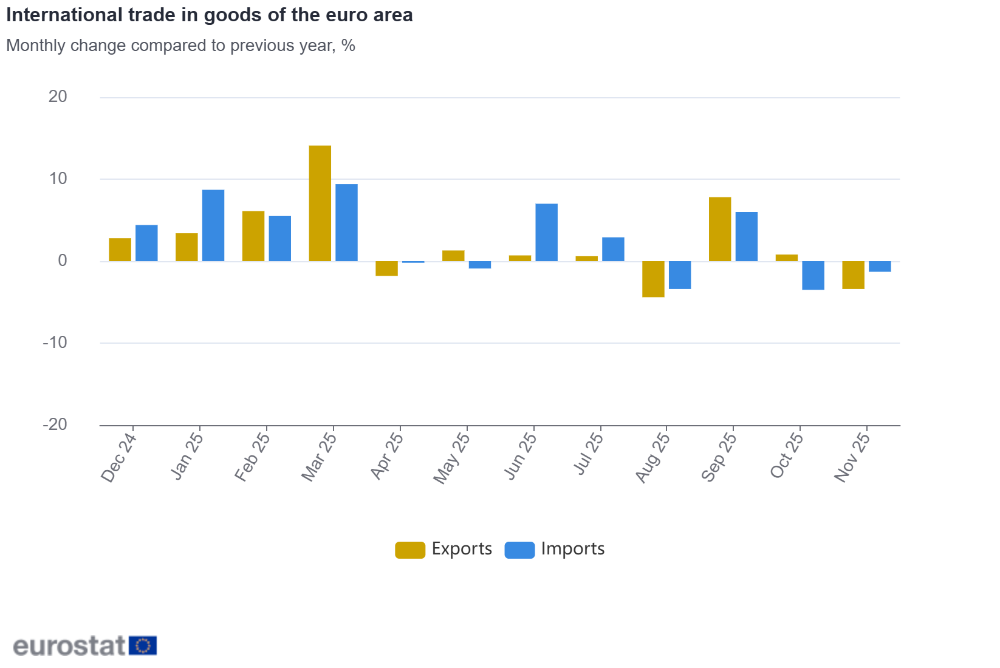
In November 2025, the euro area balance decreased compared to October 2025, with the overall surplus amounting to €9.9 billion. Compared to November 2024, the euro area balance decreased by €5.5 billion. This negative change was mainly due to declines in all groups related to manufactured goods, partially offset by improvements in the energy sector, where the deficit decreased from €-24.3 billion in November 2024 to €-17.6 billion in November 2025.
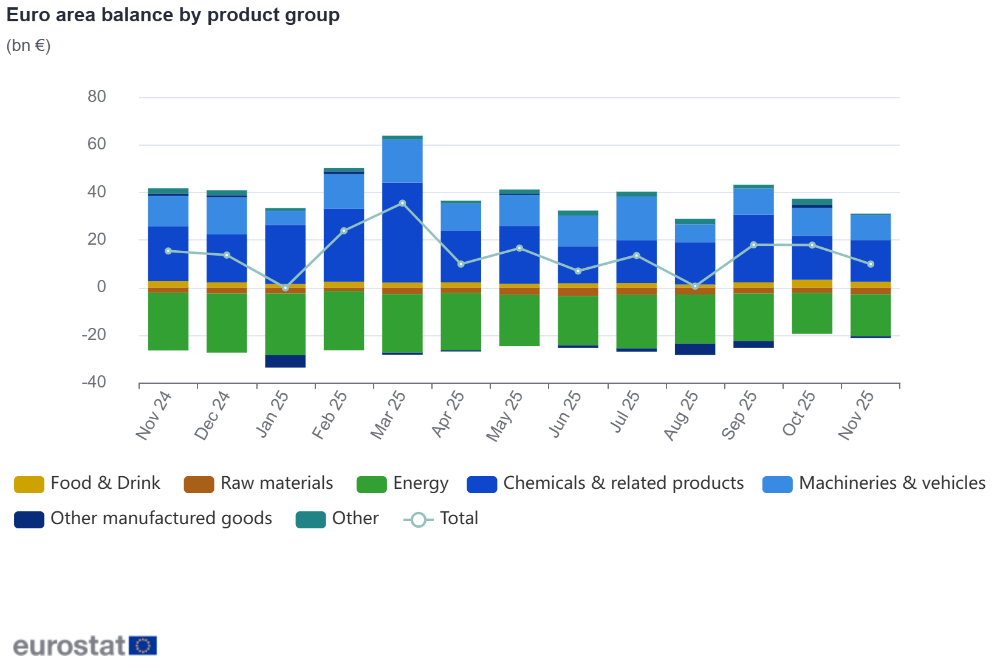
In January to November 2025, the euro area recorded a surplus of €152.7 bn, compared with €156.8 bn in January-November 2024.
The euro area exports of goods to the rest of the world rose to €2 702.4 bn (an increase of 2.3% compared with January-November 2024), and imports rose to €2 549.7 bn (an increase of 2.6% compared with January-November 2024).
Intra-euro area trade rose to €2 422.0 bn in January-November 2025, up by 1.6% compared with January-November 2024.
|
Euro area trade - non seasonally adjusted data (bn €) |
||||||
|---|---|---|---|---|---|---|
|
Flows |
Nov 24 |
Nov 25 |
Growth |
Jan-Nov 24 |
Jan-Nov 25 |
Growth |
|
Extra-EA exports |
248.7 | 240.2 | -3.4% | 2 641.3 | 2 702.4 | 2.3% |
|
Extra-EA imports |
233.3 | 230.3 | -1.3% | 2 484.5 | 2 549.7 | 2.6% |
|
Extra-EA trade balance |
15.4 | 9.9 |
|
156.8 | 152.7 |
|
|
Intra-EA trade |
219.3 | 220.9 | 0.8% | 2 383.0 | 2 422.0 | 1.6% |
|
Source dataset: ext_st_ea_sitc
|
||||||

European Union
The EU balance showed a €8.1 bn surplus in trade in goods with the rest of the world in November 2025, compared with +€11.8 bn in November 2024.
The EU exports of goods in November 2025 were €213.8 billion, down by 4.4% compared with November 2024 (€223.6 bn).
Imports from the rest of the world stood at €205.7 bn, down by 2.9% compared with November 2024 (€211.8 bn).
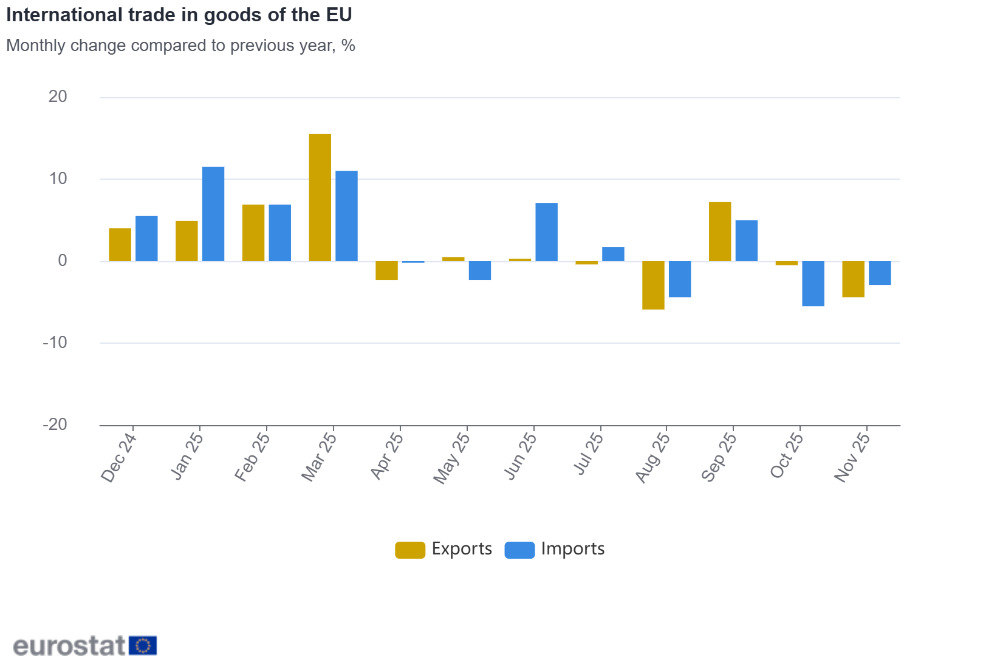
In November 2025, the EU balance decreased compared to October 2025, with the overall surplus amounting to €8.1 billion. Compared to November 2024, the EU balance decreased by €3.7 billion. This negative change was mainly due to surplus decrease in manufactured goods sectors, particularly machineries & vehicles and other manufactured goods. The only group which registered an improvement was the energy sector, with the deficit decreasing from €-28.2 billion in November 2024 to €-20.4 billion in November 2025.
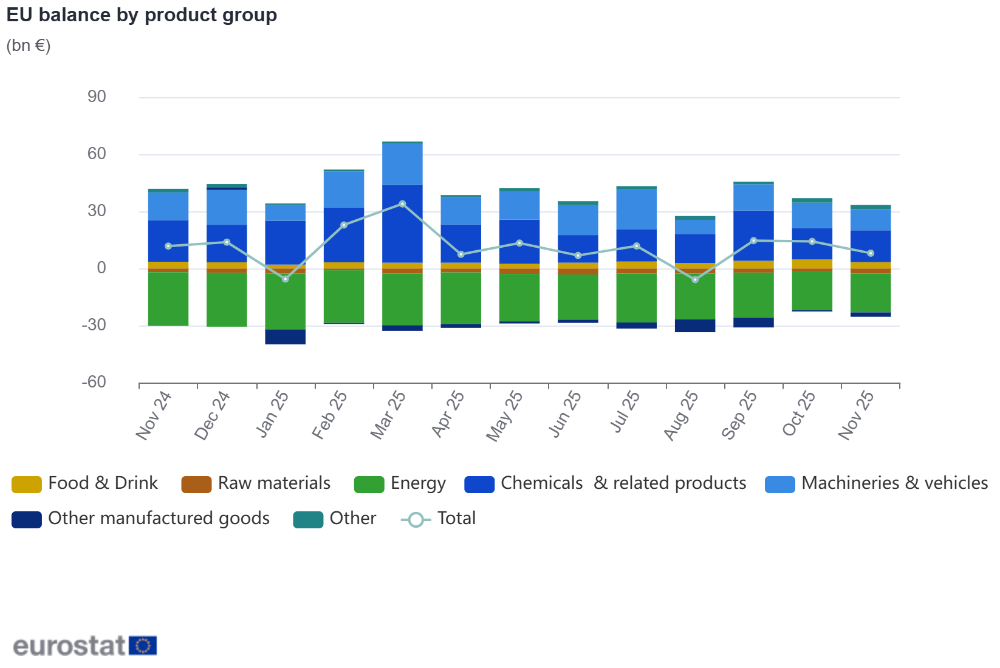
In January to November 2025, the EU recorded a surplus of €122.4 bn, compared with €128.0 bn in January-November 2024.
The EU exports of goods rose to €2 429.0 bn (an increase of 2% compared with January-November 2024), and imports rose to €2 306.6 bn (an increase of 2.3% compared with January-November 2024).
Intra-EU trade rose to €3 820.4 bn in January-November 2025, +2.2% compared with January-November 2024.
|
EU trade - non seasonally adjusted data (bn €) |
||||||
|---|---|---|---|---|---|---|
|
Flows |
Nov 24 |
Nov 25 |
Growth |
Jan-Nov 24 |
Jan-Nov 25 |
Growth |
|
Extra-EU exports |
223.6 | 213.8 | -4.4% | 2 382.1 | 2 429.0 | 2.0% |
|
Extra-EU imports |
211.8 | 205.7 | -2.9% | 2 254.1 | 2 306.6 | 2.3% |
|
Extra-EU trade balance |
11.8 | 8.1 |
|
128.0 | 122.4 |
|
|
Intra-EU trade |
349.4 | 351.8 | 0.7% | 3 738.3 | 3 820.4 | 2.2% |
|
Source dataset: ext_st_eu27_2020sitc
|
||||||
|
Main products - EU Bn €, monthly change compared to previous year |
||||||
|---|---|---|---|---|---|---|
|
|
Extra-EU exports |
Extra-EU imports |
||||
|
|
Nov 25 |
Growth rates |
Nov 25 |
Growth rates |
Nov 25 |
Nov 24 |
|
213.8 |
-4.4% |
205.7 |
-2.9% |
8.1 |
11.8 |
|
|
Primary goods: |
32.7 |
-3.6% |
52.4 |
-13.4% |
-19.7 |
-26.5 |
|
Food & drink |
17.8 | -1.6% | 14.4 | -0.6% | 3.4 | 3.6 |
|
Raw materials |
5.7 | -2.2% | 8.3 | 7.4% | -2.6 | -1.9 |
|
Energy |
9.2 | -7.9% | 29.7 | -22.5% | -20.5 | -28.2 |
|
Manufactured goods: |
175.4 |
-5.0% |
150.0 |
1.1% |
25.4 |
36.4 |
|
Chemicals |
43.3 | -12.8% | 26.6 | -4.6% | 16.7 | 21.8 |
|
Machinery & vehicles |
86.1 | -1.3% | 75.0 | 3.3% | 11.1 | 14.6 |
|
Other manuf’d goods |
46.0 | -3.6% | 48.3 | 1.3% | -2.3 | 0.0 |
|
Other |
5.6 |
13.0% |
3.4 |
10.4% |
2.2 |
1.9 |
|
Source dataset: ext_st_eu27_2020sitc
|
||||||
|
Main trading partners - EU Bn €, monthly change compared to previous year |
||||||
|---|---|---|---|---|---|---|
|
|
Extra-EU exports |
Extra-EU imports |
Trade balance |
|||
|
|
Nov 25 |
Growth rates |
Nov 25 |
Growth rates |
Nov 25 |
Nov 24 |
|
China |
16.4 | -1.2% | 48.7 | 3.8% | -32.3 | -30.3 |
|
United States |
37.4 | -20.3% | 26.7 | -7.1% | 10.7 | 18.2 |
|
United Kingdom |
28.4 | -6.0% | 13.0 | -4.7% | 15.4 | 16.5 |
|
Switzerland |
18.7 | 6.7% | 12.3 | -1.9% | 6.4 | 5.0 |
|
Türkiye |
9.6 | -3.6% | 8.1 | 1.1% | 1.5 | 1.9 |
|
Norway |
5.9 | 9.2% | 7.6 | -3.4% | -1.7 | -2.4 |
|
Japan |
5.3 | -19.4% | 5.1 | -5.0% | 0.2 | 1.3 |
|
India |
4.2 | 3.5% | 5.8 | -13.8% | -1.6 | -2.6 |
|
South Korea |
4.2 | -14.6% | 5.6 | -14.2% | -1.4 | -1.5 |
|
Mexico |
4.4 | 13.3% | 3.1 | 27.9% | 1.3 | 1.4 |
|
Source dataset: ext_st_eu27_2020sitc
|
||||||
Annex - Seasonally adjusted data
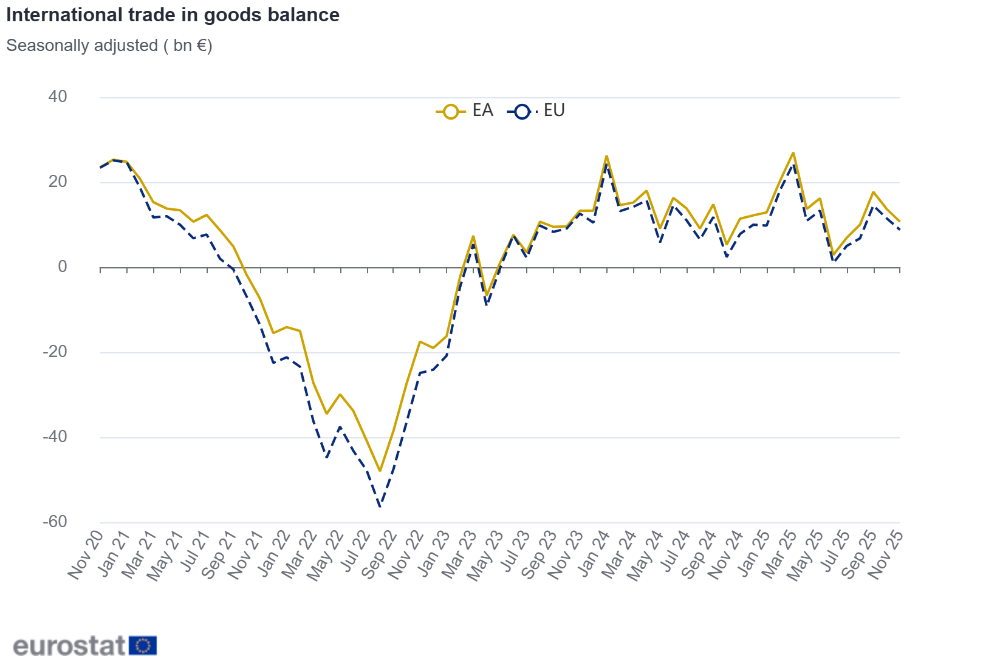
In November 2025 compared with October 2025, euro area seasonally adjusted exports increased by 1.1%, while imports increased by 2.5%. The seasonally adjusted balance was €10.7 bn, a fall compared with October (€13.7 bn).
In November 2025 compared with October 2025, EU seasonally adjusted exports increased by 2.0%, while imports increased by 3.5%. The seasonally adjusted balance was €8.8 bn, a fall compared with October (€11.5 bn).
In September-November 2025, euro area exports to non-euro area countries rose by 1.3%, while imports fell by 1.8%. Intra-euro area trade rose by 0.1%. During the same period, EU exports to non-EU countries increased by 0.8%, while imports fell by 2.7%. Intra-EU trade increased by 0.8%.
|
EA and EU trade - seasonally adjusted data - (bn €) |
|||||
|---|---|---|---|---|---|
|
|
Oct 25 |
Nov 25 |
growth rates |
Sep-Nov 25 |
Growth rates (compared to the previous three months) |
|
Euro area |
|
|
|
|
|
|
Extra-EA exports |
236.3 | 238.8 | 1.1% | 723.3 | 1.3% |
|
Extra-EA imports |
222.6 | 228.1 | 2.5% | 681.3 | -1.8% |
|
Balance |
13.7 | 10.7 |
|
42.1 |
|
|
Intra-EA |
219.2 | 219.2 | 0.0% | 659.8 | 0.1% |
|
EU |
|
|
|
|
|
|
Extra-EU exports |
209.8 | 213.9 | 2.0% | 645.8 | 0.8% |
|
Extra-EU imports |
198.3 | 205.1 | 3.5% | 610.9 | -2.7% |
|
Balance |
11.5 | 8.8 |
|
34.9 |
|
|
Intra-EU |
347.3 | 348.3 | 0.3% | 1 045.5 | 0.8% |
|
Source Datasets: ext_st_ea_sitc (Euro area), ext_st_eu27_2020sitc (EU)
|
|||||
Notes for users
Revisions and timetable
This News Release is based on information transmitted by Member States to Eurostat before 12 Jan 2026 figures are provisional. For more details, see information on data.
Methods and definitions
Statistics on trade in goods are transmitted monthly by the Member States, in accordance with the standard set out in Commission Implementing Regulation (EU) 2020/1197. For each reference month, Member States must compile statistics covering their total extra- and intra-EU trade by using estimates, where necessary. These data are available within 40 days after the end of the reference month, enabling euro area and EU aggregates to be disseminated within around 46 days.
Member States provide Eurostat with raw data, which are adjusted for calendar and seasonal effects by Eurostat. The European aggregates are computed with the indirect approach (by Member States) for total imports and exports, which guarantees additivity between the aggregate and its respective components. The estimation of seasonally adjusted data is based on the Tramo-Seats procedure, which is available in the software JDemetra+.
Data are broken down by broad categories of products as defined by the one-digit codes of the Standard international trade classification (SITC).
Geographical information
Up to 31 December 2025, the euro area included Belgium, Germany, Estonia, Ireland, Greece, Spain, France, Croatia, Italy, Cyprus, Latvia, Lithuania, Luxembourg, Malta, the Netherlands, Austria, Portugal, Slovenia, Slovakia and Finland (EA20). From 1 January 2026, the euro area also includes Bulgaria (EA21).
The aggregate data series commented on in this Euro indicator release refer to the official composition of the euro area in the most recent month for which data are available. Thus, Euro indicator releases with data for months up to December 2025 comment on EA20 series, while releases with data for January 2026 onwards will comment on EA21 series.
The European Union (EU27) includes Belgium, Bulgaria, Czechia, Denmark, Germany, Estonia, Ireland, Greece, Spain, France, Croatia, Italy, Cyprus, Latvia, Lithuania, Luxembourg, Hungary, Malta, the Netherlands, Austria, Poland, Portugal, Romania, Slovenia, Slovakia, Finland and Sweden.