Learning from data: Volkswagen Group launches Europe-wide initiative for greater road safety

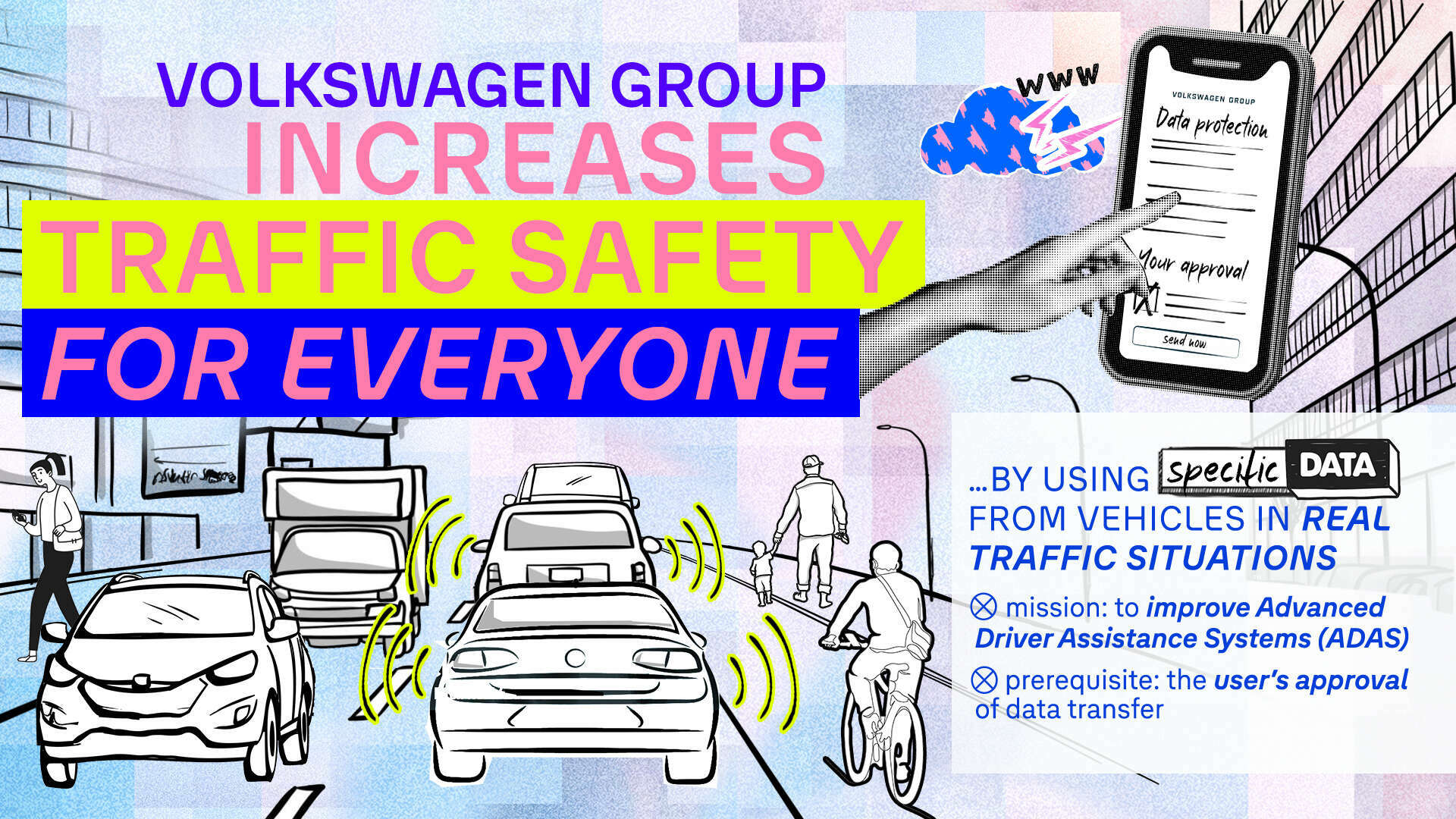
- Volkswagen Group brands aim to further optimize driver assistance systems using sensor and image data from customer vehicles and real traffic situations
- Positive contribution to overall road safety is expected
- Customer consent is a fundamental prerequisite
- Planned rollout across around 40 European countries starting January 2026
Wolfsburg. The Volkswagen Group is committed to further enhancing safety for all road users across Europe. Building on successful experiences in Germany, the Group aims to expand its program for utilizing sensor and image data from customer vehicles to around 40 European countries. The goal is to continuously optimize driver assistance systems and automated driving functions using data from real traffic situations. Customers can benefit from these improvements through software updates to their vehicles. The ongoing enhancements to driving functions increase comfort and make a positive contribution to overall road safety. Customer consent is required – naturally in full compliance with all national and European data protection regulations. The rollout is scheduled to start in January 2026 with Volkswagen Passenger Cars models, followed by CUPRA, ŠKODA, Volkswagen Commercial Vehicles, Audi and Porsche.
The Volkswagen Group’s extensive vehicle fleet is already contributing to improved road safety today. Among other things, the vehicles use anonymized swarm data to generate high-resolution maps. This helps vehicles, for example, to maintain lane guidance on roads without lane markings. It also enables precise driving recommendations and hazard alerts, which can be refined by local weather conditions. This “wisdom of the crowd” is already making road traffic safer for everyone.
To continuously improve driver assistance systems, engineers at Volkswagen Group now aim to use data from real driving situations. These are significantly more practical than tests with prototypes or simulations. The goal is to design assistance functions so that customers perceive them as effective and ideally keep them activated at all times. Active systems not only enhance safety for the drivers themselves but also for all road users around them.
Specific data transmission only in special situations
For their work, the engineers focus on particular scenarios where driver assistance systems are especially useful. These can include traffic situations involving cyclists and pedestrians, such as intersection traffic near an elementary school, or busy, complex supermarket parking lots.
Data transmission can be triggered by the emergency braking assistant, manual full braking, and sudden evasive maneuvers. Certain sensor, functional, and image data are particularly relevant in these cases. These include camera images of the vehicle’s surroundings and detection results from the environment sensors, as well as driving direction, speed, and steering angle. Information on weather, visibility, and lighting conditions also plays an important role.
An illustrative example: The vehicle should analyze movements at pedestrian crossings and sidewalks as accurately as possible. If the camera detects pedestrians moving toward the street – for instance, playing children – the vehicle can proactively build up brake pressure to enable even faster braking in an emergency.
Continuous data transmission for this purpose does not take place. Customer consent is the fundamental prerequisite for the transfer and processing of data. This consent can be given through various channels and is implemented individually by each brand – for example, as an option in the customer profile. Consent can be revoked at any time.
Data Transmission may also involve pedestrians and cyclists
Data collection and transmission may also include other vehicles or road users such as pedestrians and cyclists in the immediate surroundings. This is essential because camera-based systems must visually classify objects and people accurately, even under challenging conditions, and correctly assess complex traffic situations.
All data protection regulations are, of course, strictly observed. Individual information about people in the traffic environment is not relevant.
Interested parties can request further information or review details of Volkswagen Group’s data capture practices and privacy statements for each brand at the time of the respective brand launch dates on the brands’ central privacy portals and websites.
For Volkswagen Brand, which is the first to go live with this Europe-wide initiative for greater road safety, the privacy policy can be found under the following link: traffic-safety